
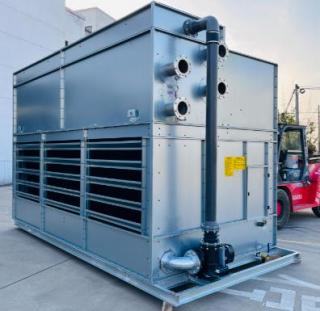
Open / Closed Type
Cooling Tower
Open or closed cooling towers use evaporative cooling to reject heat relative to the outdoor wet-bulb temperature. The source gives a 2–3°C approach, 27°C cooling water at 35°C dry-bulb / 24°C wet-bulb conditions, and 34.5°C cooling water at a 31.5°C wet-bulb condition. It cites secondary supply ≤36°C and 20 W/kW power per unit heat exchange for that example. Annual free-cooling suitability depends on local weather and the server liquid-temperature limit.
Discuss this productFeatures & technical specifications4 specification tables
| Climate / cooling requirement | Water availability | Recommended cold source |
|---|---|---|
| Low ambient temperature; year-round free cooling possible | Abundant | Closed or open cooling tower |
| Low ambient temperature; year-round free cooling possible | Scarce | Dry cooler |
| High ambient temperature; mechanical-cooling backup needed | Abundant | Chiller + cooling tower + plate heat exchanger |
| High ambient temperature; mechanical-cooling backup needed | Scarce | Air-cooled chiller |
| Design parameter | Primary side | Secondary side |
|---|---|---|
| Supply temperature | Recommended ≤35°C, considering local weather and required secondary supply; W45 or W+ allowed where cooling requirements permit | Recommended 40–48°C for energy efficiency; temperature and flow must meet liquid-cooled component requirements |
| Supply / return temperature difference | 6–10°C; ideal 8–10°C | 5–10°C; recommended ideal 6–8°C |
| Comparison item | Closed cooling tower | Evaporative dry cooler |
|---|---|---|
| Energy efficiency | Relatively superior | Relatively inferior |
| Footprint | Small | Large |
| Cost | Low | High |
| Annual water consumption | Approximately 1.8–2.0 L/(kW·h) | <0.5 L/(kW·h); varies by city |
| Peak 12-hour water usage | Relatively high | Relatively low |
| Suitable regions | Abundant water resources | Water-scarce regions; strict WUE limits |
| Year-round waterless operation | Not possible | Not possible; water needed during high outdoor temperatures, waterless operation possible at other times |
| Parameter | Source value |
|---|---|
| Type | Open or closed |
| Heat-rejection basis | Evaporative / wet bulb |
| Approach Δt | 2–3°C |
| Reference ambient dry bulb / wet bulb | 35°C / 24°C |
| Reference cooling-water temperature | 27°C |
| High wet-bulb example | 31.5°C |
| Cooling water at high wet bulb | 34.5°C |
| Supported secondary liquid supply in example | ≤36°C |
| Power per unit heat exchange | 20 W/kW |
Reference conditions & selection notes
- Weather and water-temperature figures are source design examples, not universal performance guarantees. The secondary ≤36°C example on slide 21 differs from the 40–48°C efficiency guidance on slide 22 and applies to a different design discussion.
- The water-use comparison on slide 23 specifically names closed cooling towers; its values are not assigned to every open tower.
- W45 and W+ are retained as source designations; the presentation does not define those temperature classes further.
Liquid Cooling Manual, pp. 21–23